
Prayer to the Morrigan: Source, Adaptation, and Daily Practice
Apr 10, 2026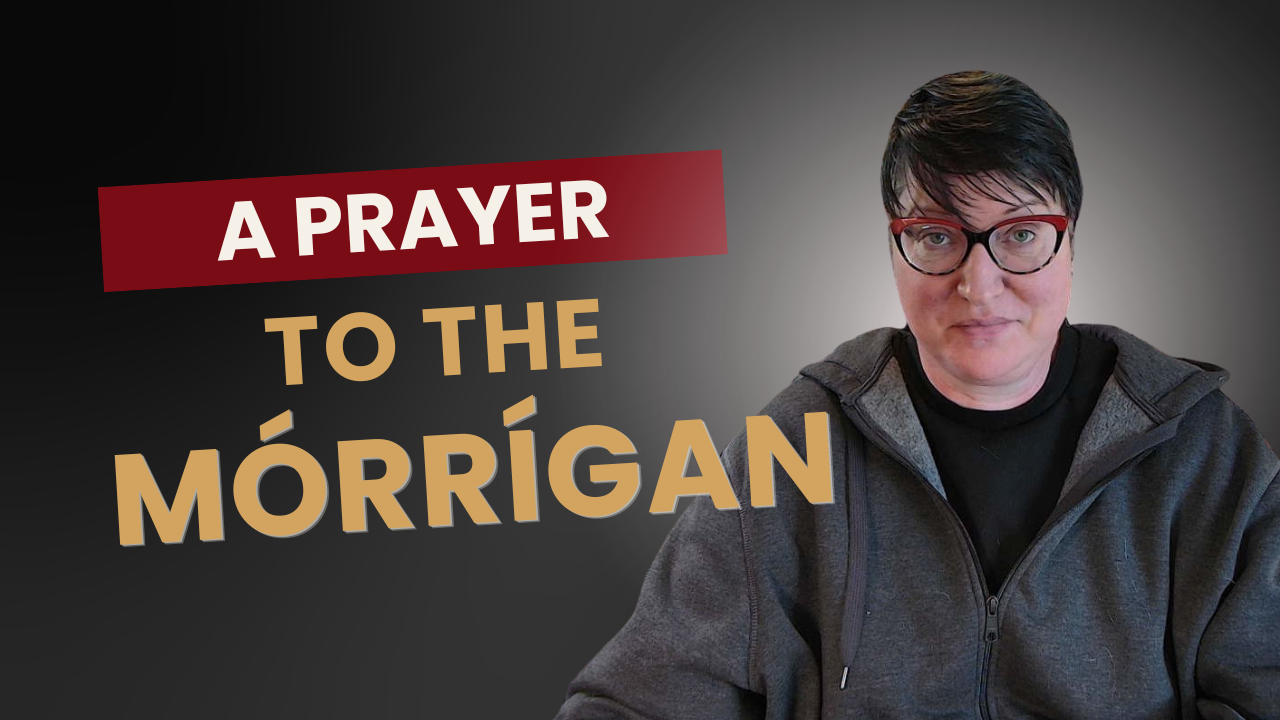
If you’ve spent any time looking for a genuine prayer to the Mórrígan, you’ll know the problem. Most of what circulates online was invented recently or pulled from traditions that have nothing to do with Ireland.
What I use is different. My evening prayer to the Mórrígan comes from the Dúchas Schools Collection, a 1930s archive of Irish folk tradition, and adapted respectfully with every word of it chosen deliberately.
In this post I’ll take you through where it comes from, what I changed, and how I use it at the end of each day. Or, you can watch the video on our YouTube channel!
Where This Morrigan Prayer Comes From
The source is the Dúchas Schools Collection at duchas.ie. In the late 1930s, the Irish government organised a project where primary school children across the country collected stories, prayers, customs, and local knowledge from their families and communities.
The result is one of the most important archives of everyday Irish life in existence, and it’s publicly accessible.
The specific entry I adapted reads: ‘The following prayer is generally recited in the evening at the setting of the sun and it was regarded as being the best prayer for the ending of each day.’
The prayer itself begins: ‘Night is falling, dear mother, the long day is o’er, and before thy loved image I’m kneeling once more, to thank thee for keeping me safe through the day, to ask thee this night to keep evil away.’
Now, as ye may have noticed, that’s a Catholic prayer. It’s addressed to the Virgin Mary, and I won’t be dressing it up as anything else.
But the structure of it, a spoken acknowledgment at sunset, gratitude for the day’s protection, a request for the night’s safety... that’s a far older pattern than the Church in Ireland.
The early Irish Church was skilled at absorbing existing practice into Christian forms. The liminal moment at sunset, the threshold between one day and the next, was already spiritually significant in Irish life before Christianity arrived. What the Church did was dress an existing practice in new clothes.
What I’ve done is take the structure back.
What I Changed in the Morrigan Prayer
- ‘Dear mother’ becomes ‘great queen.’ The Mórrígan isn’t my mother. That word implies unconditional nurturing and forgiveness, a divine parent always on your side. That’s not who she is and it’s not what she offers. ‘Great queen’ is a translation of one of the meanings of her name. It places her correctly from the first word.
- ‘Kneeling’ becomes ‘showing up.’ I don’t kneel before the Irish gods. For me, raised in Ireland in a culture where kneeling was tied to a specific and often damaging religious experience, that gesture carries body memory that has nothing to do with the Mórrígan. ‘Showing up’ is honest. It means I’m present, I’m accountable, I’m here, and that’s what she’s getting from me.
- ‘Evil’ becomes ‘dishonour.’ Good versus evil is a Christian moral binary, an it’s not the framework that Irish tradition before Christianity operated in. Honour and dishonour are different: a concrete social and spiritual standard embedded in your relationships and your obligations. When I ask the Mórrígan to keep dishonour away, I’m asking for something specific that I can actually act on in each day and night.
- The Irish closing is added. ‘Mó ghrá dhuit, Mórrígan abú’ means roughly ‘my love to you, the Mórrígan, forever.’ Abú shows up most often these days in GAA, Gaelic sports culture, attached to a county name, like - Waterford abú for example. It means forever, but with an energy somewhere between a rally cry and a declaration of allegiance. Using Irish matters to me because she is an Irish goddess and I'm an Irish person, and that living connection to the language keeps the practice grounded in something real.
The Full Morrigan Prayer
|
“Night is falling, great queen. The long day is o’er, and before your beloved image I’m showing up once more, to thank you for keeping me safe through this day, to ask you this night to keep dishonour away. Mó ghrá dhuit, Mórrígan abú.” |
How to Use This Morrigan Prayer in Daily Practice
This prayer works at sunset, and it also works just before sleep whenever ya get there, because in the older Irish understanding of the day, sunset was the beginning of the new day, which made it the natural close of the working hours.
Whether you catch actual sunset or you’re saying this in the dark at ten at night, the orientation is the same: the day is done, you’re accounting for it, and you’re asking her to hold what comes next.
You don’t need an altar, and a single candle is enough if you want something to focus on. Even just stillness and honest intention will do.
The repetition is the point: say it enough evenings and it becomes its own threshold, marking the shift from doing to resting and signalling to your whole system that the day is complete and accounted for. Ritual repetition at liminal time is not superstition. It’s applied psychology rooted in very old practice.
This is daily practice, not high ritual. It’s quieter than a significant working, and more essential, because it’s what you actually do, day after day, in ordinary time. Sustained ordinary work is always what builds the relationship.
Mórrígan Abú!
If you want to work with the Irish Goddess Mórrígan at this level, building a practice grounded in the Irish sources and in Right Relationship with who she actually is, the Morrigan Intensive is where that work happens.
Six months of curriculum, primary sources, community, and consistent practice, taught by Rev. Lora O’Brien MA from Ireland. Enrollment opens this year on 20th April 2026.
The Morrigan Intensive → morrigan.academy/intensive
About Rev. Lora O’Brien MA
Lora is a Priest of the Mórrígan since 2004 and an Irish Draoi with over thirty years of dedicated practice. She holds an MA in Irish Regional History, managed the Crúachán/Rathcroghan archaeological complex for ten years, and is the author of eight books on Irish tradition, including The Morrigan: Ireland’s Goddess (Llewellyn, 2025).
Frequently Asked Questions
What is the Dúchas Schools Collection?
The Dúchas Schools Collection is an archive of Irish folk life gathered in the late 1930s, when the Irish government organised primary school children across the country to collect prayers, stories, customs, and local knowledge from their communities and families. The resulting material covers everyday belief and practice across Ireland and is publicly accessible at duchas.ie.
Why does Lora say ‘showing up’ instead of kneeling?
Lora doesn’t kneel before the Irish gods. For her, raised in a Catholic culture in Ireland, the physical act of kneeling before a divine figure is tied to specific religious experiences that have nothing to do with the Mórrígan. ‘Showing up’ is the honest alternative: it means being present, accountable, and there, without importing the wrong body memory into the relationship.
What does ‘Mó ghrá dhuit, Morrigan abú’ mean?
‘Mó ghrá dhuit’ means ‘my love to you’ in Irish. ‘Abú’ is a word used in Gaelic sports culture attached to a county or team name, meaning ‘forever.’ Together the phrase means roughly ‘my love to you, the Mórrígan, forever.’ Lora uses it as a closing declaration of allegiance and devotion.
Can I use this prayer if I’m not from Ireland?
You can say this prayer wherever you are. Lora teaches students from around the world. The adaptations she’s made are grounded in her own cultural experience as an Irish person, and she explains that reasoning openly so you can understand it rather than just copy it. Right Relationship with the Mórrígan is about honesty and grounded practice, not about where you were born.
What is the difference between daily practice and ritual working?
Daily practice is the quiet, consistent work you do at the threshold of each day: short, specific, and repeated. Ritual working is a more intentional, structured act with deliberate setup and intent. Both matter, but they serve different purposes. Daily practice builds the relationship over time in a way that occasional ritual alone won’t. The evening prayer is daily practice. Its power comes from repetition, not from intensity.
Don't Miss Enrollment!
Join to receive the latest updates as we open our
6 Month Intensive Programme ONLY once per year.
We hate SPAM. We will never sell your information, for any reason.
![Understand the Morrigan by Mastering the Cath Maige Tuired in One Month [even if you're juggling a hectic schedule, unsure about the Irish language, and feel overwhelmed by the complexity of the Morrigan's lore.]](https://kajabi-storefronts-production.kajabi-cdn.com/kajabi-storefronts-production/file-uploads/themes/2153484210/settings_images/f22efa1-18b7-c42f-a324-c70e4af6106_48b0ce90-e56c-4cd5-b929-1f7bd7edfa8a.png)


